Artificial windows
Give a windowless room a view of the outdoors and daylight-coloured light, without opening the wall. A backlit landscape photograph in a deep aluminium frame, designed in Paris for offices, hospitals and care homes.
The principle
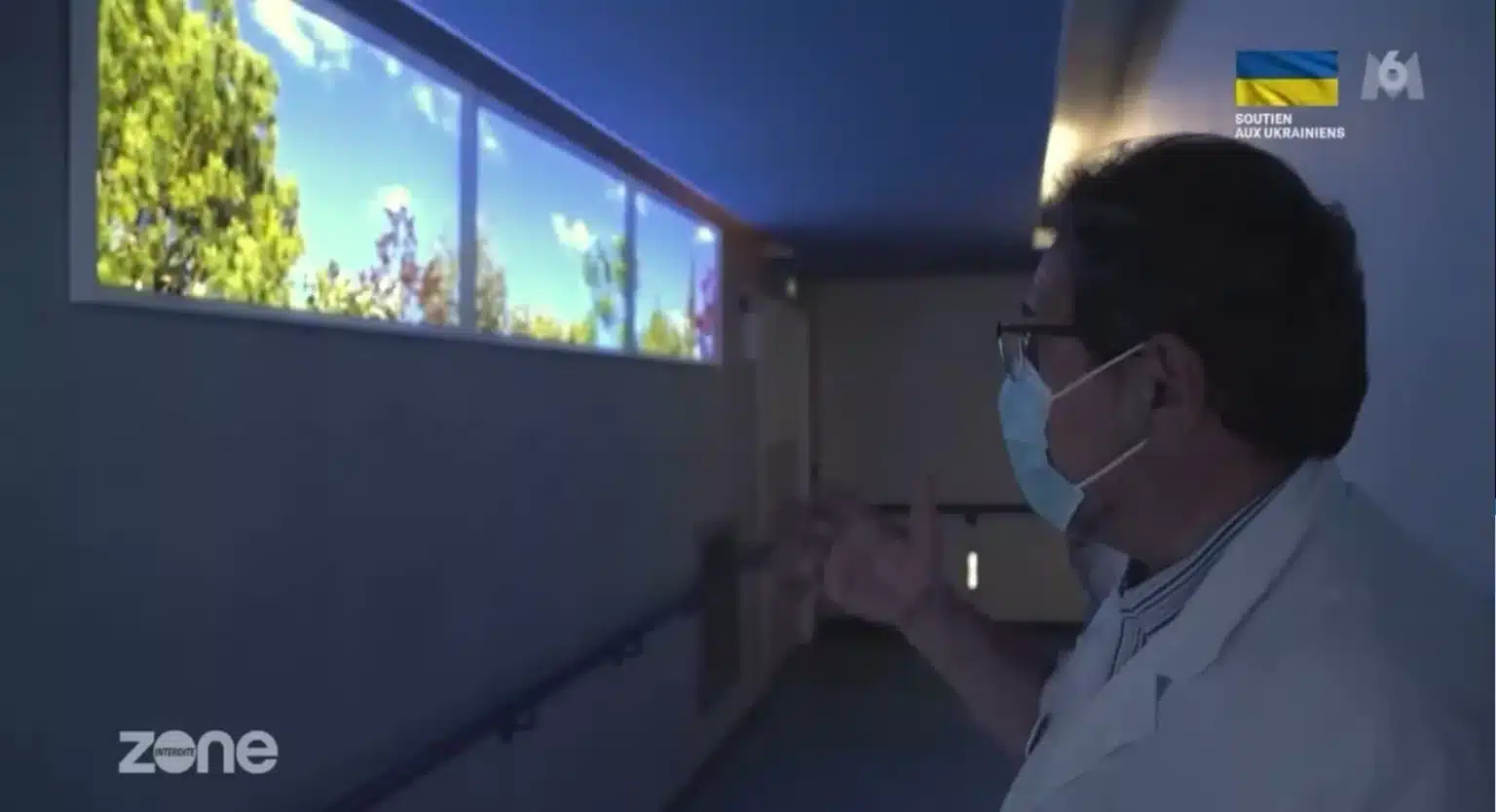
An artificial window is a wall-mounted light fitting that recreates the look of a real window: a landscape photograph, lit from behind by an LED panel and set in a bevelled frame that gives it depth. It brings a view and daylight-coloured light into rooms where no real window can be built.
The three names answer the same need. Fake and faux windows usually describe a backlit picture like ours, while a virtual window more often means a screen playing video. Ours is a printed photograph: no pixels, no glare and no loop to notice.

The range
Both measure 60 x 120 cm and share the same frame and image panel. What sets them apart is the light.
Custom images are made to order. Browse the image catalogue.

Where it works
Anywhere a real window is out of the question. Pick a room to see how it changes once the wall opens up.

A desk facing a blank wall is the situation we are called in for most. One window at eye level gives the room a horizon and a source of daylight-coloured light, without touching the façade.

Long meetings in a closed room drain attention. A pair of windows along one wall opens the space up and changes how it feels from the moment you walk in.

A break needs somewhere to look. Staff who spend their shift underground or in the core of a building get a view of the outdoors for as long as the break lasts.

Patients and staff in windowless wards lose track of the time of day. Circadian windows keep track of it for them: warmer in the morning and evening, cooler around midday.
Why Cumulux
Most fake windows on the market are sold for home basements. Ours are built for workplaces and hospitals, where they stay on eight hours a day or more and have to meet fire and electrical standards.
Questions
What buyers ask us before ordering. Anything else, call the Paris showroom on +33 1 71 18 24 99.
Yes, that is exactly what an artificial window is. An LED panel lights a landscape photograph from behind, and a 53 mm bevelled aluminium frame gives it the depth of a real window reveal. Once switched on, it reads as an opening in the wall rather than a lit picture.
A virtual window is usually a screen playing video. Ours is a printed photograph lit from behind: no pixels, no blue screen glow and nothing that looks like a television. It is also designed to stay on all day, with LEDs rated for 50,000 hours.
It hangs on the wall on the fixings supplied, or sits recessed in a plasterboard wall for a flush finish. Each window arrives pre-wired with a 2.5 m cable, and an electrician connects it to the lighting circuit. No opening in an external wall and no planning permission.
It adds real, daylight-coloured light, but it works alongside your existing lighting rather than replacing it. The classic model gives 2,860 lumens at 6,000 K. The circadian model shifts from 2,700 K to 6,500 K through the day, following the rhythm of natural light.
Yes. Choose from our catalogue of landscapes, all shot by the Cumulux photographer, or send us your own photograph at 300 DPI minimum. The image panel slides out of the frame, so the view can be changed later without replacing the window.
